The gap between Shanghai and New York is not just an arbitrage opportunity. It is a referendum on whether silver is priced as a financial claim or as an industrial necessity—and on which monetary system gets to write the terms.
Two benchmarks, one metal: what the Shanghai–COMEX spread is really measuring
The silver market now speaks with a faintly schizophrenic voice. One price is minted in the West, in venues designed to let investors and hedgers trade exposure cheaply and at scale. The other is forged in China, where a great deal of manufacturing lives and where the instinct, increasingly, is to treat silver as a strategic input. The spread between Shanghai and the Western benchmark is the market’s way of admitting that these two worlds are no longer clearing the same marginal transaction.
On paper, the discrepancy is straightforward: Shanghai sometimes trades at a premium—measured by converting the Shanghai Gold Exchange’s deferred silver price into dollars and comparing it with a Western reference. Goldsilver.ai publishes precisely this “Shanghai Silver Price in Dollars” and a corresponding premium/discount series, noting that local industrial demand, currency moves and regional market conditions can push Shanghai above London/Western pricing.
Yet the deeper point is institutional. China’s contracts are built to keep a live pathway from “I want price exposure” to “I want bars”. The West’s flagship venue is the COMEX, built to keep that pathway available—but rarely used—because most participants prefer to offset or roll positions rather than take delivery. CME’s own educational material makes the broader principle bluntly: “most futures positions are offset or rolled forward” and only a small share go to delivery. The spread is what happens when one market is dominated by rollovers and the other is dominated by requests for metal.
Microstructure matters: paper price discovery versus physical clearing
Calling COMEX “paper” is not an insult; it is a description of purpose. Futures exist so that miners, refiners, manufacturers and investors can transfer risk without shifting tonnes of bullion around the planet every week. Delivery is the anchor, not the routine. COMEX’s rulebook is explicit: the standard silver contract is for 5,000 troy ounces, with minimum fineness requirements and approved brands; delivery is effected through the exchange’s warehouse system. The system is serious, regulated and engineered to converge. But it is also engineered to be liquid, which means it attracts a lot of participants who do not want the bother, cost or balance-sheet implications of taking bars.
Shanghai’s design leans the other way. On the Shanghai Gold Exchange, deferred contracts use a tender-for-delivery system: long holders can tender to take delivery, short holders can tender to make it, and if neither happens the position can roll with a deferred interest mechanism. On the Shanghai Futures Exchange, silver futures are RMB-denominated and physically delivered, with specified delivery units and rules that treat delivery as an integrated feature, not an exotic endgame. Put these mechanics together and the spread starts to look less like a quirk and more like a clearing price for immediacy: China is often paying not for “silver exposure” but for “silver certainty”.
Solar: green transition priced in silver
If you want the simplest industrial explanation for why Shanghai pays up, look at solar. Silver is used in conductive pastes and contacts; engineers may shave the loading per cell, but policymakers are installing so much solar capacity that aggregate consumption remains heavy. The World Silver Survey reports photovoltaic demand of 197.6m ounces in 2024, placing it among the largest single industrial sinks. Meanwhile, the same survey notes that industrial demand overall hit a record 680.5m ounces in 2024, powered by the electrification stack that solar sits atop.
China is not merely a consumer of solar power; it is the factory floor of the global solar supply chain. When a country’s industrial policy is tied to expanding solar deployment and exporting solar hardware, it develops a low tolerance for feedstock uncertainty. That intolerance shows up as a local premium: better to pay a few dollars more per ounce inside a domestic market than to risk a production line pausing because someone else cornered the prompt metal. The spread, in this reading, is an “energy-security premium” masquerading as a commodity anomaly. Once a metal becomes essential to the infrastructure of decarbonisation, it begins to behave like oil did in the 20th century: its availability becomes political, not just commercial.
EVs and charging: small quantities, multiplied mercilessly and Chinese dominance
Electric vehicles are not silver-intensive in the way solar panels can be; they are silver-distributed. The metal shows up in the places where modern traction systems are most unforgiving: high-current contacts, relays, switches, fuse links, and connector interfaces that must survive heat, vibration and repeated arcing without drifting out of spec. In an EV, the electrified architecture is denser and more power-hungry than in an internal-combustion car, because propulsion is mediated through inverters, DC–DC converters and battery-management electronics that cycle large currents through compact footprints.
Silver is favoured in contact materials and conductive pastes because it offers excellent conductivity and good resistance to oxidation, helping maintain low contact resistance—a small parameter that can translate into meaningful thermal losses at high currents. The rapid roll-out of fast charging makes the engineering constraint even tighter: higher voltages and higher amperage raise the penalty for contact degradation, and component designers lean on silver-bearing alloys and coatings to preserve performance across thousands of connect–disconnect cycles.
As a result, “grams per vehicle” can look trivial until you recall that reliability in power electronics is not a marketing feature; it is a safety requirement. Where substitution is possible, it is typically slow, because it requires redesign, qualification, and long validation cycles to ensure that any new material does not introduce failure modes in the field.
However, the more consequential story sits upstream in the battery economy, where silver’s role is less about a single chemistry and more about the industrial ecosystem that makes storage scale. Batteries are a platform technology now—spanning grid storage, consumer electronics, data-centre backup, industrial machinery and defence—so the demand shock is not confined to passenger cars. Silver enters this wider battery landscape through the electronics that manage power flows (current collectors, interconnects, control circuitry), through high-reliability connectors and busbars in battery packs and racks, and through the broader electrification stack that grows alongside storage: inverters, power modules and protection systems.
As stationary storage expands to stabilise renewable-heavy grids, the emphasis shifts from energy density alone to longevity, thermal performance and low-loss switching—domains where silver-containing contacts and high-conductivity interfaces retain an advantage. This is why the Shanghai–COMEX spread remains informative even when the discussion drifts from “cars” to “batteries”: industrial users in China are not merely pricing the vehicle cycle; they are pricing the build-out of an electricity system in which storage is as central as generation. The premium is, in effect, a signal that silver is being pulled not by one product category, but by the whole electrified economy that batteries enable.
The scale effect is magnified by geography. In 2024 China produced 12.4m electric cars—more than 70% of global output, making it not merely the biggest EV market but the manufacturing centre of gravity. It also sits atop the battery stack: the IEA says China produces over three-quarters of batteries sold globally, and academic syntheses put 2024 lithium-ion output at roughly 1,170 GWh, about three-quarters of world production. That concentration turns China’s electrification push into a sustained bid for processed materials, not just mined ones.
Silver is particularly exposed because much of supply is recovered as a by-product of lead/zinc (and often copper) smelting, meaning the metal’s availability is entangled with the economics—and policy—of base-metal refining. Analysts and market commentators routinely describe China as a dominant hub for refined silver as well, with estimates clustering around 60–70% of global refining/processing capacity—a chokepoint that bites hardest when EVs, solar and electronics are scaling simultaneously.
The same logic extends beyond silver: battery and EV supply chains pull hard on tin (solder), copper (conductors), zinc (galvanising and alloys), iron/steel (structures, grids, industrial plant), and—most geopolitically—rare earths and other refined “strategic minerals” whose export and processing Beijing has increasingly treated as instruments of industrial security.
Silver, reclassified: China tightens the spigot; America elevates the metal
For years, silver’s strategic role was a market argument. In 2026 it has become policy. From January 1st 2026, China has shifted to a licensing regime for silver exports, turning what used to be a commercial flow into an administrative permission. Reuters reports that Beijing has designated 44 companies that will be allowed to export silver in 2026–2027—a structure that narrows the channel and makes volume, timing and counterparties more contingent on government approval.
Commentary in the financial press has framed the move as a strategic lever over refined silver supply chains, noting that China sits at a crucial chokepoint in globally traded refined silver. In a market where the Shanghai premium already signals industrial urgency, export licensing adds something worse than higher prices: uncertainty about availability. Washington, meanwhile, has started to speak the same language—if not with the same instruments.
In November 2025, the US government’s official 2025 List of Critical Minerals (published by the USGS under the Department of the Interior) added silver among ten new inclusions, explicitly treating it as a material relevant to national and economic security and supply-chain resilience. The upshot is conceptual but consequential: once a metal is “critical”, the state gains stronger justification for stockpiling, permitting support, industrial incentives and—where politics demands—trade measures. Put the two together and the Shanghai–COMEX spread looks less like a pricing oddity than a map of diverging policy regimes: China is rationing exports of a key input; America is formally admitting it cannot treat silver as merely a shiny hedge.
History’s echo: when China set the silver premium, and taught empires to fear it
The idea that silver can trade “dearer” in China is not new; it is practically a footnote to the first globalisation. In the late Ming period, fiscal reforms culminated in taxes being increasingly commuted into silver payments—a “silverisation” of public finance that deepened domestic demand for the metal. With China absorbing silver as a tax-paying medium, the metal’s relative value rose. Scholarly work on the Manila galleon trade shows the gold–silver ratio could be dramatically different between China and the Spanish empire (with China valuing silver more highly relative to gold), creating an arbitrage that funnelled American silver across the Pacific. The imperial motive was prosaic: when a state insists on being paid in a metal, that metal becomes scarce at home—and therefore expensive.
That same magnetic pull for silver later unsettled Britain. Chinese manufactures (tea, silk, porcelain) drew bullion eastward, leaving Britain with a persistent trade deficit paid in specie. The corrective was the opium trade: British merchants pushed Indian opium into China, often paid in silver, reversing the flow and fuelling addiction and political crisis—one of the sparks for the Opium Wars. In other words, the contest over who gets the silver—and on what terms—has form: when trade and policy combine to concentrate metal in one jurisdiction, the response is rarely polite commerce. It is coercion, substitution and eventually gunboats.
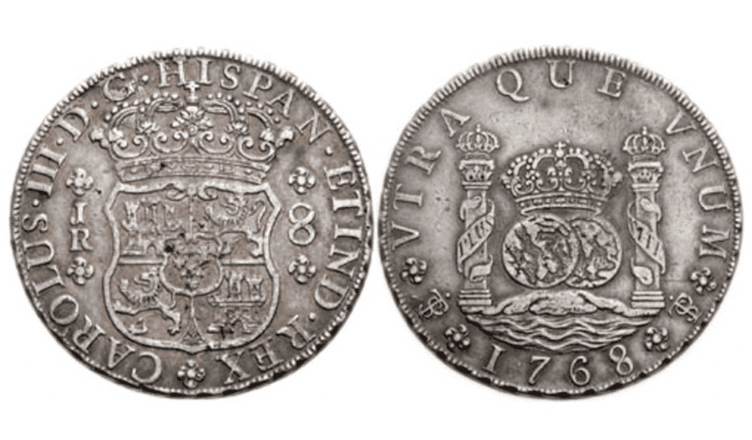
America’s own monetary instincts were shaped by a more practical, less imperial lesson: stability comes from trustworthy coin, not from dependence on a distant capital. British restrictions and chronic coin shortages in the colonies meant that foreign specie—especially the Spanish milled dollar, prized for its consistent silver content—became the workhorse of everyday commerce. The Spanish dollar was not merely familiar; it was available, and its uniformity made it credible as a unit of account—one reason it became the “unofficial national currency” of much of colonial America. The reluctance to anchor monetary life to “English” coinage was not aesthetic: it was political economy. A new republic seeking autonomy from London had little appetite for a monetary system whose lifeblood depended on the former imperial centre. Spanish silver offered an external, widely accepted anchor—useful precisely because it was not sterling.
The modern spread has then an old ancestry: China’s demand has long been able to set a premium, and the West has long tried—through policy, substitution or force—to avoid being priced out of a metal it suddenly discovers it needs.
From spread to monetary geopolitics: silver as the new oil, with a monetary aftertaste
Seen through that historical lens, the Shanghai–COMEX spread is less an aberration than an early-warning siren. In the 20th century, oil became the strategic commodity that structured diplomacy and finance. The dollar was not legally pegged to oil, but it was entangled with it: energy trade, pricing conventions and financial plumbing reinforced the dollar’s utility. Silver is now edging into a comparable role for the 21st century’s infrastructure—renewables, electrification, data centres and certain defence technologies—while also retaining its character as a monetary metal.
That combination makes it more geopolitically combustible than many “critical minerals”: it is both input and symbol. The spread itself is the mechanism by which this shift becomes legible. If COMEX remains the world’s dominant venue for trading silver exposure, it will continue to set a global reference price shaped by leverage, liquidity and rollovers. If Shanghai increasingly becomes the venue where industrial demand is settled with physical delivery—and where state priorities can reinforce domestic premiums—then pricing power will become contested between a dollar-centred derivatives system and an RMB-centred physical-clearing ecosystem. The architecture for that is already visible: SHFE’s physically delivered silver contract in RMB, and SGE’s tender-for-delivery system that turns positions into metal when needed.
The long-run consequence is not a Victorian return to a silver standard. It is something more subtler: a world where access to strategic commodities influences currency regimes indirectly. Oil once underpinned the dollar’s global usefulness because no industrial economy could ignore it. If silver becomes comparably indispensable—while also being a metal that people instinctively trust as a save heaven—then both the dollar and the yuan may find themselves increasingly over time “referenced” to silver: through stockpiles, long-term offtake contracts, settlement mechanisms and pricing hubs. The spread is only the first crack in a single global price. It may also be the first clue that the monetary map is being redrawn.
Are we witnessing a transition in the hegemonic currency?
A third implication is beginning to emerge from the plumbing. As Shanghai’s deliverable ecosystem grows in importance, RMB-denominated settlement for silver looks less like a domestic convenience and more like an incipient reference standard: the currency attached to the venue that can most credibly clear physical metal tends to gain gravitational pull over time. Conversely, a benchmark ecosystem dominated by paper exposure and roll-over behaviour—however efficient for hedging—risks looking like a monetary layer floating above the commodity rather than anchored to it.
The consequence is not that the dollar suddenly collapses, but that marginal trade and procurement decisions start to habituate firms to RMB settlement where the metal is actually being allocated—much as industrial actors once habituated themselves to dollar conventions because energy trade demanded it. This is where the thread from earlier sections tightens: export licensing , China’s outsized EV-and-battery manufacturing footprint and refining dominance, and Shanghai’s persistent premium all point in the same direction—towards the currency of the dominant physical clearing hub gaining practical advantage.
Nor is this only about silver. Commodity settlement follows industrial inertia: where factories cluster, supply chains shorten, inventories turn faster and productivity rises, the local currency gains utility as a settlement instrument. China’s ability to pair scale manufacturing (solar, EVs, batteries) with processing chokepoints in strategic materials turns “currency choice” into a by-product of supply-chain efficiency. In that sense, silver is a leading indicator—one of the first widely traded metals where the Shanghai premium and deliverable market architecture are openly signalling that the centre of economic gravity has shifted.
If the West is pricing a financial claim while China is pricing a physical input, the spread is not merely a market quirk: it is the market telegraphing who is setting the terms of the new industrial order and the begining of the hegemonic currency transition.
FIAR